
Call us now :08045816367
 Send Inquiry
 Send Inquiry
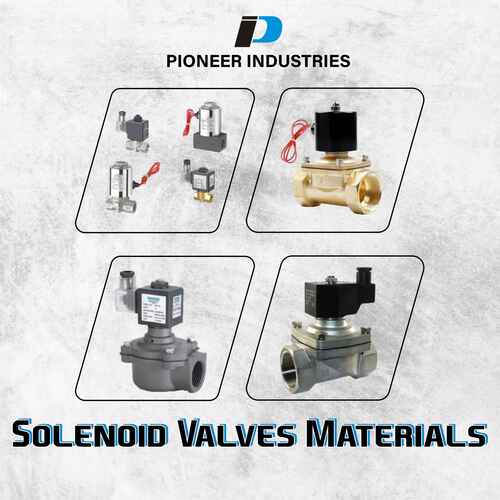
Pneumatic Brass Valves
Pneumatic Brass Valves Specification
- Type
- 2/2 Way, 3/2 Way
- Material
- Brass
- Power
- 6VA
- Pressure
- 0.5 to 10 Bar
- Voltage
- 24V DC / 220V AC
- Electrical Entry
- DIN Connector
- Thread Type
- BSP / NPT
- Manifold Type
- Single / Multiple
- Working Presssure
- 0.5 to 10 Bar
- Media
- Air, Water, Oil
- Port Size
- 1/4 to 2
About Pneumatic Brass Valves
We bring forth for our clients a comprehensive array of high quality Pneumatic Brass Valves. These valves are highly demanded in chemical. oil, pharmaceutical and other allied industries for controlling the motion of a fluid along a pipe or tube. Offered valves are efficiently manufactured by utilizing superior quality raw materiel under the supervision of our technical experts in conformity with international quality standards. Besides, we provide these Pneumatic Brass Valves at pocket friendly price.
Features:
- Dimensional accuracy
- High functionality
- Sturdiness
- Rugged design
General Specifications
- Types: 2/2 Way, 3/2 way.
- Material of construction: Aluminium / Brass / SS-304 / SS316 / P.P. /PTFE.
- Media: Air / Gases / Liquid / Vacuum / Haz Chemicals.
- Weather Proof as per IP-67.
- Flame Proof as Per IS 2148-1981.
Technical Specifications
- Direct Acting Range: 1/8" to 1"
- Internal Pilot Type Range: 1/8" to 3".
- External Pilot Type Range: 1/8" to 3".
- Diaphragm operated Range: 1/8" to 3".
- Y - Type Angle Valve Range: 1/4" to 3".
- Pressure Range: Vacuum to 70 kg.
- Operation: Normally Open / Normally Close.
- Seat: NBR / VITON / NEOPRENE / PTFE / EPDM / SILICON.
- Temp: -40 degree c to 180 degree c.
- Coil Encl: Fly leads/Terminal Box/Plug-in-Conn.
- Coil Type: Size I / Size II.
Coil Voltage:
- Size I - AC Volt- 12/24/48/60/110/220/380/440 V--6 W.
- Size II - DC Volt-12/24/48/60/110/220V--8W.
Diaphragm Valves
Type: 2/2 Way Pilot Operated Diaphragm Valve.
General Specifications
- Media: Dry or Lubricated Air / Inert Gases / Water / Oil.
- Nominal Diameter: 8 to 50 mm.
- Material of construction: Aluminium / Brass / Steel(Optional).
- Internals: SS / Brass.
Technical Specifications
- Port Sizes: 1/4" bsp to 2" bsp
- Max Pressure: 40 kg/cm2.
- Sealing Disc: Nitirile / Vition / Silicon (Optional).
- Design: Pilot Operated / Poppet Type
Reliable Fluid Control for Diverse Applications
Engineered for precise control, these pneumatic brass valves excel in fluid automation systems, thanks to rapid response, dependable sealing, and IP65-rated protection. Whether you manage air, water, or hydraulic circuits, they deliver consistent performance under challenging conditions.
Flexible Installation and Electrical Configuration
The valves support both BSP and NPT thread types, easily adapting to your existing setups. With DIN connector electrical entry and compatibility for varied voltages (24V DC or 220V AC), integration becomes straightforward across industrial automation scenarios.
FAQs of Pneumatic Brass Valves:
Q: How do pneumatic brass valves with NBR or Viton seals improve fluid control systems?
A: NBR and Viton seals enhance reliability and chemical compatibility, enabling effective control of diverse fluids like air, water, and oil. They provide durable, leak-resistant performance even in demanding industrial environments.Q: What installation positions are suitable for these valves?
A: These brass valves can be installed in any position, providing exceptional flexibility in system design and ensuring optimum functionality regardless of the mounting orientation.Q: When is it advantageous to use normally closed versus normally open operating modes?
A: The choice depends on safety and operational needs. Normally closed valves block fluid flow by default and open on energization, ensuring fail-safe operation, while normally open valves allow flow until powered, convenient for systems requiring flow unless intentionally stopped.Q: Where are these pneumatic brass valves commonly applied?
A: They are widely used in automation, process control, and fluid distribution systems across industries like manufacturing, chemical processing, water treatment, and HVAC applications.Q: What is the process for selecting the correct valve orifice diameter and pressure range?
A: Application requirements such as flow rate, system pressure (0.5 to 10 Bar), and compatible orifice size (2 mm to 50 mm) should be assessed to ensure optimal performance and longevity of the valve.Q: How do manifold options and thread types benefit installation and system flexibility?
A: Single or multiple manifold options streamline fluid distribution, while BSP and NPT thread types offer compatibility with various piping systems, simplifying installation and expansion.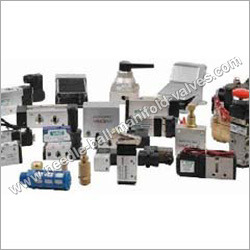
Tell us about your requirement

Price:
Quantity
Select Unit
- 50
- 100
- 200
- 250
- 500
- 1000+
Additional detail
Mobile number
Email

More Products in Pneumatic Valves Category
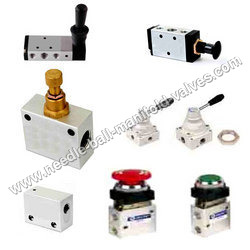
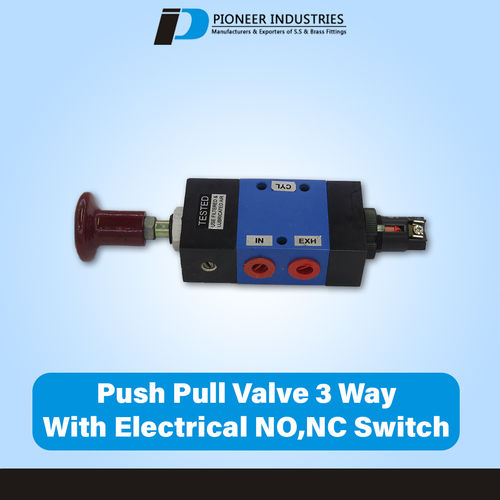
Push Pull Valve 3 Way With Electrical NO NC Switch
Price 1350 INR / Unit
Minimum Order Quantity : 1 Unit
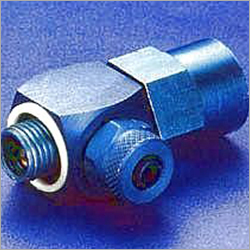

Our Main Export Markets are USA, Australia etc.
 Send Inquiry


Our Products
- Stainless Steel Tube Fittings
- Stainless steel Valves
- Manifolds Valve
- Brass Pipe Fittings
- Brass Valve
- Ball Valves
- Pneumatic Valves
- Special Valves
- Forged Brass Fittings
- Needle Valve
- Pneumatic Cylinders
- Polyurethane Tubings
- S.S.Tube Fittings
- Tube Cutters
- Air Filter Regulator Lubricator
- Quick Release Couplings By Types
- Steel Quick Release Coupling
- Pu Nylon Coil
- Stainless Steel Double Ferrule Fittings
- Quick Release Couplings By Materials
- Brass Needle Valves
- Brass Double Ferrule Fitting
- Brass Push to Lock Fittings
- Brass Vibra-Lok Fittings
- Brass Flare Fittings
- Brass PU Fittings
- Brass Compression Fittings
- Stainless Steel Single Ferrule Fittings
- Stainless Steel Flare Fittings
- Brass Inverted Flare Fittings
- Stainless Steel Check Valves
- Stainless Steel Guage Root valves
- 2 way Manifolds Valves
- 3 way Manifolds Valves
- Bottom Loading Tanker Valves
- Tube Fittings
- Regulator Lubricant
- Hydraulic Quick Release Coupling
- Battery Life Enhancer
- Air Interlock Valve


Shop No. 5, Gokul Apartments, Kevni Pada, Off. S.V. Road, Jogeshwari (W), Mumbai - 400102, Maharashtra, India

Mr Sunil Dabholkar
(Proprietor)
Mobile :08045816367
 Send Inquiry
 Send SMS
 Call Me Free
Developed and Managed by Infocom Network Private Limited.


 English
 Spanish
 French
 German
 Italian
 Chinese (Simplified)
 Japanese
 Korean
 Arabic
 Portuguese