
Call us now :08045816367
 Send Inquiry
 Send Inquiry
316 Stainless Steel Fittings
MOQ : 50 Units
316 Stainless Steel Fittings Specification
- Product Type
- Pipe Fitting
- Material
- 316 Stainless Steel
- Type
- Elbow, Tee, Coupling, Union, Nipple, Reducer, Cap (various types available)
- Shape
- Round, Equal, Reducing (varies by fitting type)
- Technique
- Forged / Cast / Machined
- Surface Treatment
- Pickled, Polished, Shot Blasted
- Standard
- ASTM A403 / A182 / ASME B16.11
- Length
- As per fitting type or customized
- Inside Diameter
- 1/8 inch to 4 inch
- Wall Thickness
- Sch10, Sch20, Sch40, Sch80, Sch160, XXS (as per requirement)
- Tensile Strength
- 515 MPa min
- Grade
- SS316, SS316L
- Size
- Customized sizes available
- Color
- Metallic Silver
316 Stainless Steel Fittings Trade Information
- Minimum Order Quantity
- 50 Units
- FOB Port
- MUMBAI
- Payment Terms
- Telegraphic Transfer (T/T), Cash in Advance (CID)
- Supply Ability
- 1000 Units Per Week
- Sample Policy
- If order is confirmed we will reimburse the sample cost
- Main Export Market(s)
- Australia, North America, Eastern Europe, Africa, Middle East, South America, Western Europe, Asia, Central America
- Main Domestic Market
- All India
About 316 Stainless Steel Fittings
Our company is looked upon as one of the leading manufacturers and exporters of a wide range of 316 Stainless Steel Fittings. These fittings are available for clients in different standard sizes in order to meet their exact needs. We use highest quality stainless steel to manufacture these fittings in accordance with industry standards. Widely used in the installation of pipelines in industries, these 316 Stainless Steel Fittings are stringently tested by experts.
Features:
- Free of corrosion
- Abrasion resistant
- Durable quality
Available sizes:
- 1/16", 1/8", 1/4", 3/8", 1/2", 3/4", 1", 11/4" 11/2" and 2".
Working pressure:
- 100 to 350 Bar.
Exceptional Corrosion Resistance
Crafted from high-grade SS316/SS316L, these fittings provide unmatched resistance to chemicals, saltwater, and corrosive fluids. This exceptional durability makes them the preferred choice for harsh operating environments, ensuring longevity and reliable service in industries like pharmaceuticals, marine, and oil & gas.
Versatile Connection and Application
Choose from Threaded (BSP/NPT), Socket Weld, Butt Weld, or Flanged ends to suit your systems needs. These fittings support a broad media range, including water, oil, gas, and chemicals, and are available in multiple shapes and wall thicknesses, ensuring precise compatibility with diverse pipelines and industrial requirements.
Reliable Performance under Pressure
Engineered to meet a broad range of pressure requirements, these fittings support ratings from 150# up to 3000# depending on size and type. Manufactured using forged, cast, or machined techniques, and treated for optimal surface finish, they meet ASTM A403, A182, and ASME B16.11 standards, guaranteeing quality and safety.
FAQs of 316 Stainless Steel Fittings:
Q: How are 316 Stainless Steel Fittings commonly installed in industrial systems?
A: The fittings can be installed using various connection methods, including Threaded (BSP/NPT), Socket Weld, Butt Weld, or using flange connections. The chosen method depends on the systems pressure and sealing requirements, and ensures compatibility with most piping systems used in industries like chemical processing, oil & gas, and plumbing.Q: What makes SS316 fittings highly resistant to corrosion, even in saline or chemical environments?
A: SS316 and SS316L alloys contain high levels of chromium, nickel, and molybdenum, enhancing their resistance to chemicals, saline water, and aggressive fluids. This composition ensures excellent protection from rust, pitting, and crevice corrosion, particularly valuable in marine, food, and pharmaceutical sectors.Q: When should I select a specific end connection type such as Threaded, Socket Weld, or Butt Weld?
A: The choice of end connection depends on the application and maintenance needs. Threaded connections are ideal for quick assembly and disassembly, Socket Weld suits small-diameter, high-pressure lines, while Butt Weld is preferred for permanent, leak-resistant connections in larger or critical pipelines.Q: Where are these 316 Stainless Steel Fittings typically used?
A: They are utilized in a variety of sectors such as plumbing, chemical processing industries, food and pharmaceutical manufacturing, marine environments, and oil & gas installations, owing to their robustness, hygiene, and corrosion resistance.Q: What is the manufacturing process for these fittings?
A: 316 SS fittings are produced using forging, casting, or machining processes. After forming, they undergo surface treatments like pickling, polishing, or shot blasting to enhance durability and hygiene, meeting the strict quality standards of ASTM A403, A182, or ASME B16.11.Q: How do I benefit from using 316 Stainless Steel Fittings in my application?
A: By choosing these fittings, you gain outstanding corrosion resistance, compatibility with various media and pressure ratings, hygienic surfaces, and compliance with international standards. Their durability reduces maintenance needs and prolongs system life, making them a cost-effective solution.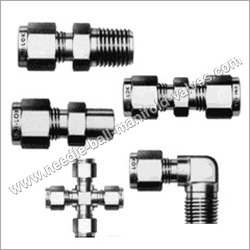
Tell us about your requirement

Price:
Quantity
Select Unit
- 50
- 100
- 200
- 250
- 500
- 1000+
Additional detail
Mobile number
Email

More Products in Stainless Steel Tube Fittings Category

Our Main Export Markets are USA, Australia etc.
 Send Inquiry


Our Products
- Stainless Steel Tube Fittings
- Stainless steel Valves
- Manifolds Valve
- Brass Pipe Fittings
- Brass Valve
- Ball Valves
- Pneumatic Valves
- Special Valves
- Forged Brass Fittings
- Needle Valve
- Pneumatic Cylinders
- Polyurethane Tubings
- S.S.Tube Fittings
- Tube Cutters
- Air Filter Regulator Lubricator
- Quick Release Couplings By Types
- Steel Quick Release Coupling
- Pu Nylon Coil
- Stainless Steel Double Ferrule Fittings
- Quick Release Couplings By Materials
- Brass Needle Valves
- Brass Double Ferrule Fitting
- Brass Push to Lock Fittings
- Brass Vibra-Lok Fittings
- Brass Flare Fittings
- Brass PU Fittings
- Brass Compression Fittings
- Stainless Steel Single Ferrule Fittings
- Stainless Steel Flare Fittings
- Brass Inverted Flare Fittings
- Stainless Steel Check Valves
- Stainless Steel Guage Root valves
- 2 way Manifolds Valves
- 3 way Manifolds Valves
- Bottom Loading Tanker Valves
- Tube Fittings
- Regulator Lubricant
- Hydraulic Quick Release Coupling
- Battery Life Enhancer
- Air Interlock Valve


Shop No. 5, Gokul Apartments, Kevni Pada, Off. S.V. Road, Jogeshwari (W), Mumbai - 400102, Maharashtra, India

Mr Sunil Dabholkar
(Proprietor)
Mobile :08045816367
 Send Inquiry
 Send SMS
Developed and Managed by Infocom Network Private Limited.


 English
 Spanish
 French
 German
 Italian
 Chinese (Simplified)
 Japanese
 Korean
 Arabic
 Portuguese